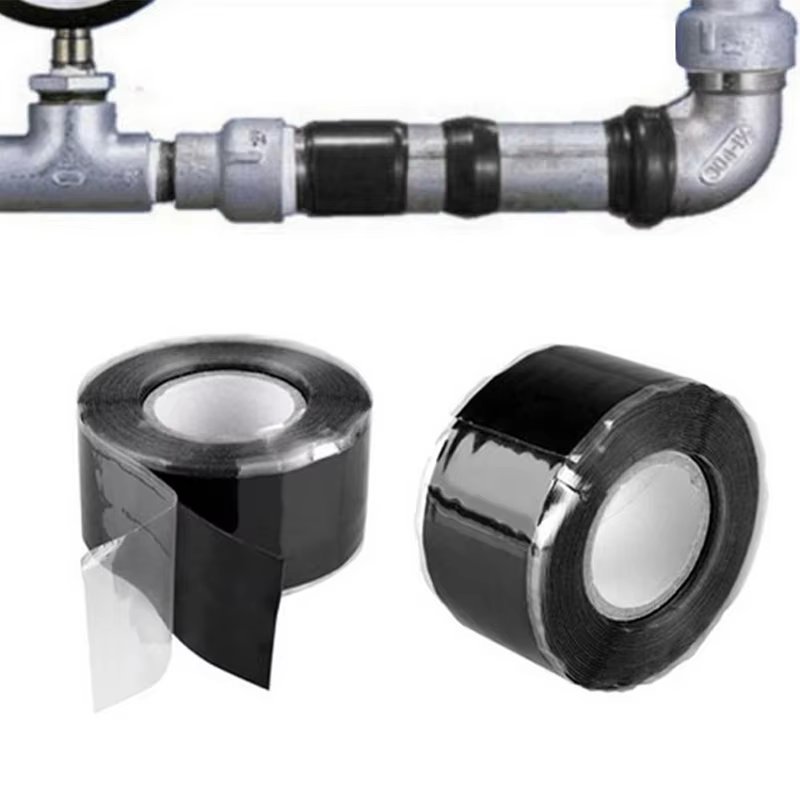
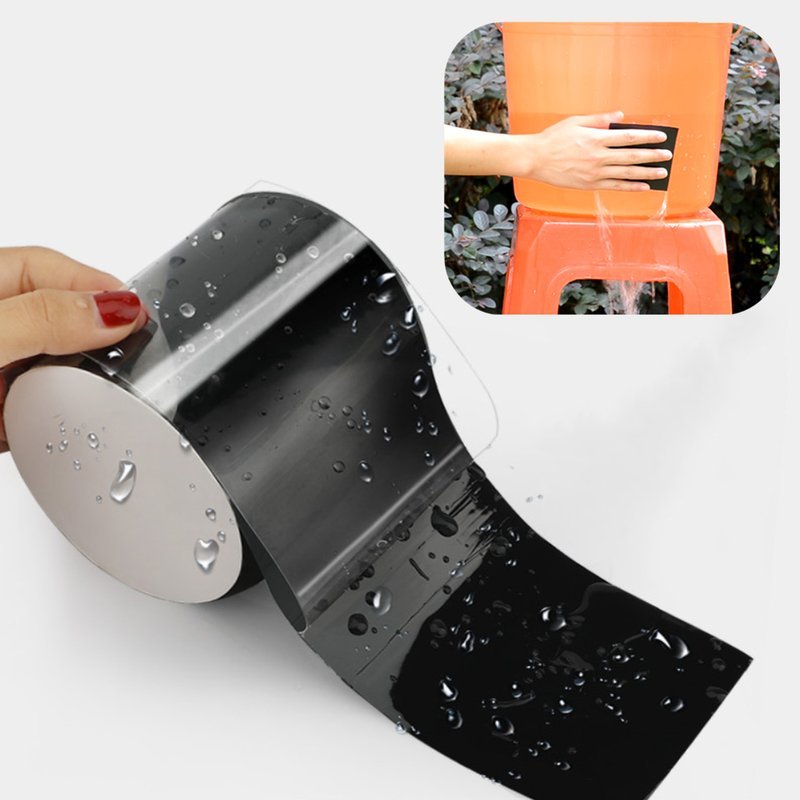
Self-fusing silicone tape contains no adhesive. It bonds to itself when stretched and wrapped under tension, forming a continuous silicone sleeve with no glue line to fail. That single difference is why it works on wet, oily and irregular pipe joints where a pressure-sensitive tape lifts within hours.
How a tape with no adhesive can hold
The tape is an uncured silicone elastomer on a liner. Stretching it exposes fresh polymer surfaces, and when those surfaces are pressed together they cross-link into one homogeneous layer. The bond is to itself, not to the pipe, so surface preparation matters far less than it does for an acrylic or rubber adhesive.
Two consequences follow. First, the tape will not stick to anything until it is stretched - applied slack, it simply unwinds. Second, the finished wrap has no edge for water to creep under, which is why it outperforms a conventional repair tape on a pressurised joint. It is also why removal means cutting it off rather than peeling it.
The working numbers for a self-fusing silicone rubber tape are set by the material rather than by the vendor. Published datasheets for the electrical grade quote thickness of about 0.3 mm (12 mil), ultimate elongation around 450%, dielectric strength near 34 kV/mm and a continuous service temperature of roughly 180 C. Those four figures tell you whether a grade belongs on a wire harness or a hot-water line, and they should be on the roll's own datasheet rather than in a catalogue headline.
Elongation is the number to check first. A tape that will only stretch to 200% cannot be pulled tight enough to knit, and it will look correct on the reel while failing on the joint. Anything in the 400% range gives enough headroom to wrap an elbow without the tape thinning out at the outside of the bend.
Where it beats a butyl or PVC wrap
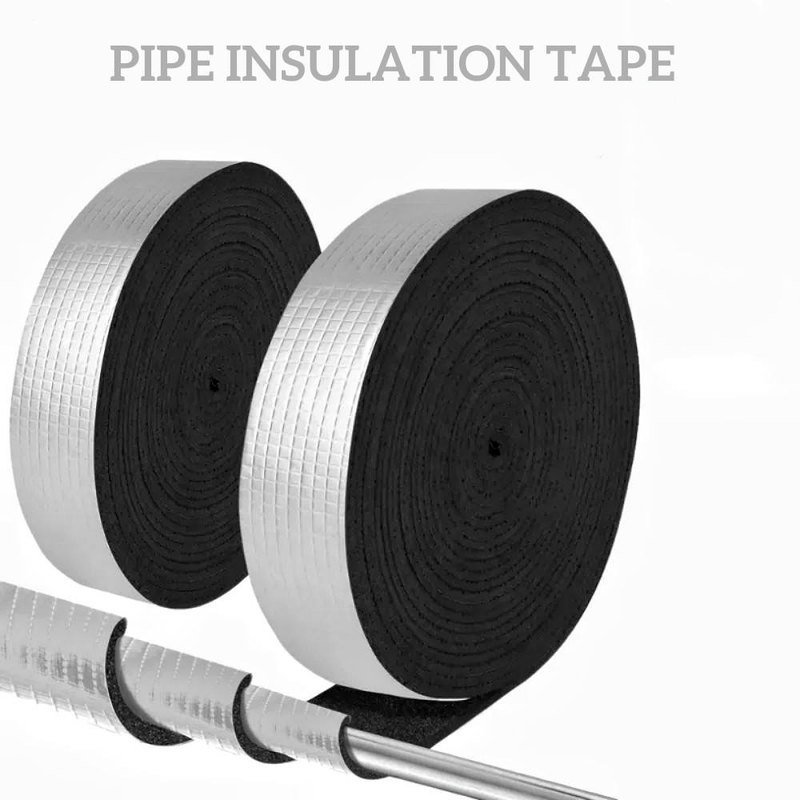
Use self-fusing silicone where the joint is wet, the pipe is irregular, or the repair has to survive movement and thermal cycling. Use a butyl or foil-faced wrap where the job is a flat surface, a roof seam, or where UV exposure is the main threat and a metallic facing is wanted.
- Water and heating pipes, hose ends, and pump connections
- Electrical and wire harness bundling, where insulation is the point
- Irregular shapes - elbows, tees, threaded fittings
- Joints that flex or move with temperature
- Not a substitute for a mechanical repair on a split pressure pipe
Tension is the whole method
The wrap fails or succeeds on tension. Stretch to roughly half again its length as you wrap, keep the overlap at half the tape width, and press each turn down onto the one beneath. Release the tension before the final turn, and hold it in place for a minute so the layers knit.
Two turns past the end of the joint in each direction is the usual rule for a water pipe. On a hose end, wrap in the direction the hose is pushed on, so the wrap tightens rather than unwinds under load. The bond continues to strengthen for the first few hours, so a joint that weeps slightly straight after wrapping is not necessarily a failed joint.
What it will not do
Self-fusing silicone is a protective wrap and a sealing wrap, not a structural repair. It will not close a split in a pressurised pipe, and it is not a substitute for a clamp on a failed fitting. Standard grades also weather poorly in prolonged direct sunlight unless a UV-stable grade is specified.
It also has a shelf life. Because the polymer is uncured, a roll stored hot or in sunlight will begin to cure on the reel and lose its ability to knit. Keep spare rolls sealed and cool, and treat a roll that has gone stiff as scrap rather than trying to stretch it back.
Widths, minimum order and how to specify
Both pipeline and hose grades are available from 100 pieces, which is low enough to test a full installation before committing to a stock position. Specify the pipe diameter range and whether the joint is under pressure, because that decides the width and the number of overlap turns rather than the material.
For a distributor range, the two SKUs that cover most of the demand are the black self-fusing silicone repair tape for hose and wire work, and the single-sided pipeline repair tape for larger diameter water lines. Ordering both rather than one means a counter enquiry about a leaking joint can usually be answered from stock.